Calculated News
Chris and Jagrup represented us at the Property Developer Show in Leeds last week, where they had some fantastic conversations with investors, developers, and fellow industry professionals.
We’re looking forward to attending more investor events in the future—keep an eye out for us! We’d love the opportunity to connect and chat.
Mortgages
Navigating today’s mortgage market can feel complex, but our team is here to make it straightforward. Whether you’re buying your first home, remortgaging, expanding your property portfolio, or funding a development, we offer tailored advice and access to a wide range of lending solutions.
Residential Mortgages: We work with a panel of trusted lenders to secure competitive rates and flexible terms that fit your circumstances — from first-time buyers to homeowners looking to remortgage or move up the ladder.
Buy-to-Let Mortgages: For investors, we provide expert guidance on structuring your portfolio effectively, helping you balance yield, risk, and tax efficiency. Our experience spans both individual landlords and limited company structures.
Commercial Mortgages: Whether you’re acquiring business premises or refinancing existing assets, we can arrange funding that supports your growth strategy. We liaise with lenders who understand the unique challenges of commercial borrowing.
Development Finance: From small refurbishments to multi-unit developments, we help secure the capital you need to bring projects to life. Our network includes specialist lenders who can offer staged funding and flexible repayment options aligned with your build schedule.
Whatever your goals, our role is to simplify the process, negotiate the best possible terms, and support you from initial enquiry through to completion. Get in touch today to discuss your options and find a solution that suits your plans.
 | Book a call with Iain Watts https://calendly.com/iain-w-calculateduk/30min |
Tax & Accounting
Companies House and HMRC Scams – Stay Alert
Sadly, the number of scams, both email and postal, targeting both newly created and existing companies is on the rise.
We have had 2 emails this week from clients who have received a letter like the one below – This is a scam – please do not scan the QR code, complete any information – or pay!

Neither HMRC , nor Companies House will send you a letter like this asking you to pay for registration:
- In the case of HMRC, we recommend you always use the https://gov.uk website to check and pay anything.
- In the case of Companies House, we complete almost all filings on your behalf, so if you receive anything and are not sure, please get in touch.
One letter you will probably receive is from the Information Commissioners Office asking the company to pay to be added to the register if the company holds personal details of clients or individuals (eg. tenants information). If you need to pay, you should ONLY pay this via the https://ico.org.uk website. There is a good “should I pay” calculator on the site. Do not register via any other site.
Another area for the scammers to target is ID Verification. Please ONLY do this via Companies House Directly (https://www.gov.uk/guidance/verifying-your-identity-for-companies-house) , at a post office, through a solicitor you know or through us.
Remember:
- All HMRC and Companies House online check, pay and file will be via the https://gov.uk website.
- ICO website is https://ico.org.uk/
- Alway err on the side of caution, if you are unsure, please check with us.
Companies House ID Verification (a reminder…)
ID Verification
Identity verification is a new legal requirement. It will help to deter people intending to use companies for illegal purposes. It is not the same as AML checks, although some of the information required may be the same.
Companies House have now confirmed that all new incorporations, and any filing for a Limited Company or LLP, including accounts filing and confirmation statements will require the personal authentication codes from all officers and members. We will continue to send reminders by email asking you to complete ID Verification through Companies House. If you are unable to please contact us as soon as possible.
You can do this by following this link to the gov.uk website:
https://www.gov.uk/guidance/verifying-your-identity-for-companies-house
By law, you will need to verify your identity to confirm you are who you claim to be.
This will:
- reduce the risk of fraud
- improve transparency, trust and accuracy of information on the Companies House register
You’ll need to verify your identity if you are:
- a director
- the equivalent of a director – this includes LLP members, general partners and managing officers
- a Person with Significant Control (PSC)
(Shareholders with a shareholding over 25% are automatically a PSC.)
- someone who files for a company – for example, a company secretary
In most cases, you’ll only need to verify your identity once.
Should you claim & repay child benefit if you are a high earner?
If you claim Child Benefit and either you or your partner earn over £60,000 per year you will have to start paying the High Income Child Benefit Charge. Earnings over £80,000 will mean you have to repay it in full, however, it’s still worth considering claiming:
- You will receive National Insurance Credits for claiming Child Benefit until your child turns 12. These count towards your State Pension.
- You can also transfer these National Insurance creditsto your partner if they are not a high earner, or to another relative (such as a grandparent) if they contribute to the care of your child
- Your child will be registered to receive a NI numbershortly before they turn 16 without you having to apply.
You can find details on how to claim on HMRC’s website https://www.gov.uk/child-benefit-tax-charge.
Important update for UK Crypto Holders: What you need to know
Starting 1 January 2026, anyone using crypto platforms in the UK will need to provide personal details—such as name, address, and National Insurance number—to those platforms. This is part of a new global reporting framework aimed at improving tax transparency. If platforms fail to collect or report this information, HMRC may issue penalties of up to £300 per user.
But that’s not all—from the 2024–25 tax year, HMRC has introduced a dedicated crypto section in the SA108, which is used to record details of the capital gains and losses from your SA100 Tax Return.
If you’ve bought, sold, swapped, or earned crypto (like Bitcoin, Ethereum, or Dogecoin), you’ll need to report any gains or income, even if they’re small.
Here’s a quick breakdown of what’s taxable:
- Capital Gains Tax (CGT): Applies when you sell or exchange crypto for a profit. The CGT allowance for 2024–25 is £3,000.
- Income Tax and National Insurance: May apply if you receive crypto through employment, mining, staking, or lending.
To stay compliant:
- Keep detailed records of all your crypto transactions.
- Make sure your 2024–25 Self-Assessment includes any crypto activity.
These changes reflect HMRC’s growing focus on digital assets, so it’s a good time to review your crypto tax position and ensure everything is in order.
Making Tax Digital for Income Tax (MTD IT)
As we begin to complete your 2024/2025 Self Assessment Tax Returns, we (and HMRC) will be checking for individuals who will be in-scope in MTD IT from 6th April 2026. If you are in scope, your client manager will be in touch to arrange a call to discuss the implications and next steps.
MTD IT applies to Sole Traders or Landlords (individuals with income from personally owned investment property).
From 6th April 2026 anyone with turnover (not just profit) of £50k or over from either or a combined source of income will be in-scope for MTD IT. The following year, it reduces to £30K and so on.
The biggest change is that HMRC will require quarterly returns using approved software plus an end of year final submission with adjustments.
The quarterly returns are based on income and expenditure. Tax payments will become due following the final return including adjustments and by 31st January of the year following the end of the financial year.
an example:
For FY 6th April 26 – 5th April 27, the Quarterly returns will be:
| Period | Due |
| Quarterly update 1: Period covered: 6 April ‘26 to 5 July ‘26 | 7th August ‘26 |
| Quarterly update 2: Period covered: 6 July ‘26 to 5 October ‘26 | 7th November ‘26 |
| Quarterly update 3: Period covered: 6 October ‘26 to 5 January ‘27 | 7th February ‘27 |
| Quarterly update 4: Period covered: 6 January ‘27 to 5 April ‘27 | 7th May ‘27 |
The Final adjustment, filing and payment of tax due must then be completed on or before 31st January 2028.
What do I need to do?
The key to keeping the cost of the extra work involved to a minimum is to keep it simple, so you should:
- Open a bank account (or use one you already have) for your business transactions.
Most approved software solutions ask for a connected bank account (read only access – like a digital bank statement).
Time spent separating business and personal transactions = more cost.
- Familiarise yourself with the new regulations.
Not all income is in-scope for MTD IT (eg Partnership income is currently out of scope), therefore you may find that you need to complete MTD IT and a normal Self Assessment tax return.
Worth noting:
If you are in-scope for MTD IT from April 2026, there will be a period from April 2026 when we will complete Both:
Your 2025-2026 Self Assessment Tax Return due by 31st January 2027
AND
Your 2026-2027 MTD Quarterly returns (due each quarter as above) and final submission due 31st January 2028.
Capital vs. Revenue Expenditure Decision Guide
We are often asked what HMRC consider capital vs revenue expenditure. The guides below should help answer some of your questions over what is revenue and what is capital in the context of repairs and improvements.
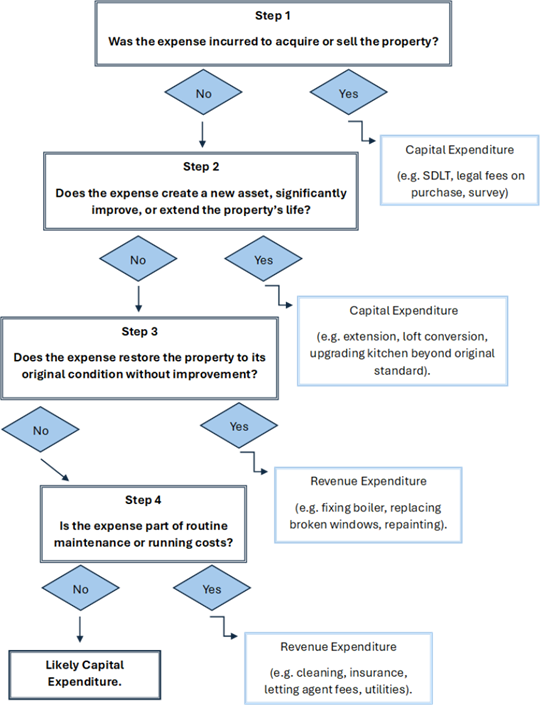
Rule of thumb:
Capital = New asset / major improvement / acquisition & disposal costs (relieved against CGT on sale).
Revenue = Repairs, running, and maintenance (deductible against rental profits in the same year).
Capital vs. Revenue Expenditure Decision Guide
| Capital Expenditure (added to cost of property, relief on disposal) | Revenue Expenditure (deductible from rental income) |
| Purchase price of property | Letting agent fees |
| Stamp Duty Land Tax (SDLT) | Repairs to broken boiler |
| Legal fees on purchase | Painting/redecorating between tenants |
| Survey costs | Routine maintenance (e.g., servicing heating system) |
| Extensions (e.g., adding a conservatory) | Replacing roof tiles like-for-like |
| Loft conversion | Insurance premiums (buildings/contents/landlord) |
| New kitchen or bathroom where standard significantly upgraded | Cleaning costs |
| Initial property improvements before first letting | Council tax, utilities (if landlord-paid) |
| Structural alterations (e.g., removing walls) | Replacing carpets like-for-like |
| Planning permission costs | Accountancy fees related to rental accounts |
Key Distinctions
- Capital Expenditure: Creates or improves an asset, increases property value, or extends its useful life. Tax relief is only available on sale (as a deduction against Capital Gains Tax).
- Revenue Expenditure: Relates to day-to-day running, maintenance, or repairs. Deductible immediately from rental income, reducing Income Tax / Corporation Tax liability in the same year.
We are always available to answer your questions by phone or email, and by Teams meeting on request.
Contact Us:
| Tax & Accounting | 01904 948860 Option 1 | tax@calculateduk.com |